
AI, Nostalgia, and Backrooms
An essay on the dangers of irreality
Writing any piece of text is akin to birth. Forming the thoughts you want to say into a readable format is difficult. This is why our writers and journalists should be paid a fair wage and have a valued place in our society. The process of writing engaging, interesting, and thoughtful text is not easy, which is why so many wish to produce art yet find themselves unable to see it through to the end. It takes time to cultivate meaning.
Our phones are something evil. They have granted us 24/7 mobile access to the world as it happens. Phones have rotted minds and taken up excessive time. The disgusting part is that the culprits behind increased screen time and addiction are making exorbitant profits from mental deterioration. The internet was once a place that felt more public. It had characteristics of democratic information sharing. People could find communities aligned with their interests while still engaging with a wide range of users and topics. Compare that to today, where much of people’s time online is dictated by an algorithm. At the same time, those online twenty years ago were living full lives outside of the internet. They lived something worth sharing; there was an experience to put before the world. The value of our internet, of our connectivity, lies in making otherwise impossible connections to people we have never met before. When viewed in an empathetic light, in a light of understanding, the internet and its connection to others bridge gaps we could never have dreamed of crossing. If that sounds corny to write down, then good. I believe that the internet is one of the greatest inventions humans have built, and it has world-altering potential for empathy and knowledge.
A library or an archive is the ripest place to obtain knowledge. In some ways, the internet is the largest archive ever created. It is filled with texts and images that portray human perspectives. While these perspectives are sometimes biased, sometimes from past worlds, sometimes selectively curated, and sometimes telling a fictitious story, they are pieces of data in understanding humans and all sorts of subjects.
We can use search engines to find a specific answer to a question, or we can go in with an open mind, see what we stumble across, and think about it. In this, there are two methods of gaining information. There is synthesis and analysis. When you Google a question in this era, where artificial intelligence is advancing exponentially and has become mainstream, you are asking for an artificial synthesis of information generated by an extensively trained large language model (LLM). You are asking for a summary of human-produced knowledge. Artificial intelligence trains on what has come before; it is inherently a derivative output. Now, is this necessarily bad? In my view, no. There are LLMs that can run exclusively on your local device, synthesizing the information they’ve been trained on. It can be quite useful for a machine to do the laborious work of combing through information and providing you with the answer you sought. However, there is a difference between getting an answer and reaching a conclusion through your own thought process and research.
Analysis differs in that it comes from the bottom up. It is valuable when the answer you seek is more complex than can be discerned from asking a single question. The meaning of life is impossible to answer in one sentence because it involves many different questions, experiences, and nuances to get to the center of what it means to be human. Although that is quite the example, nearly every subject has depth that cannot be captured by a single question. This is why one of the rules of research is to avoid going into a project with an answer in mind; the answer should come from the evidence you uncover. Reading literature, primary sources, and secondary texts with a critical eye is important for organically cultivating observations and interpretations.
The dilemma we face with AI is that it promotes reliance on synthesis. It disincentivizes the labor of obtaining knowledge in favor of instant information. The ever-increasing reduction of reality to a summary inevitably distorts nuances.
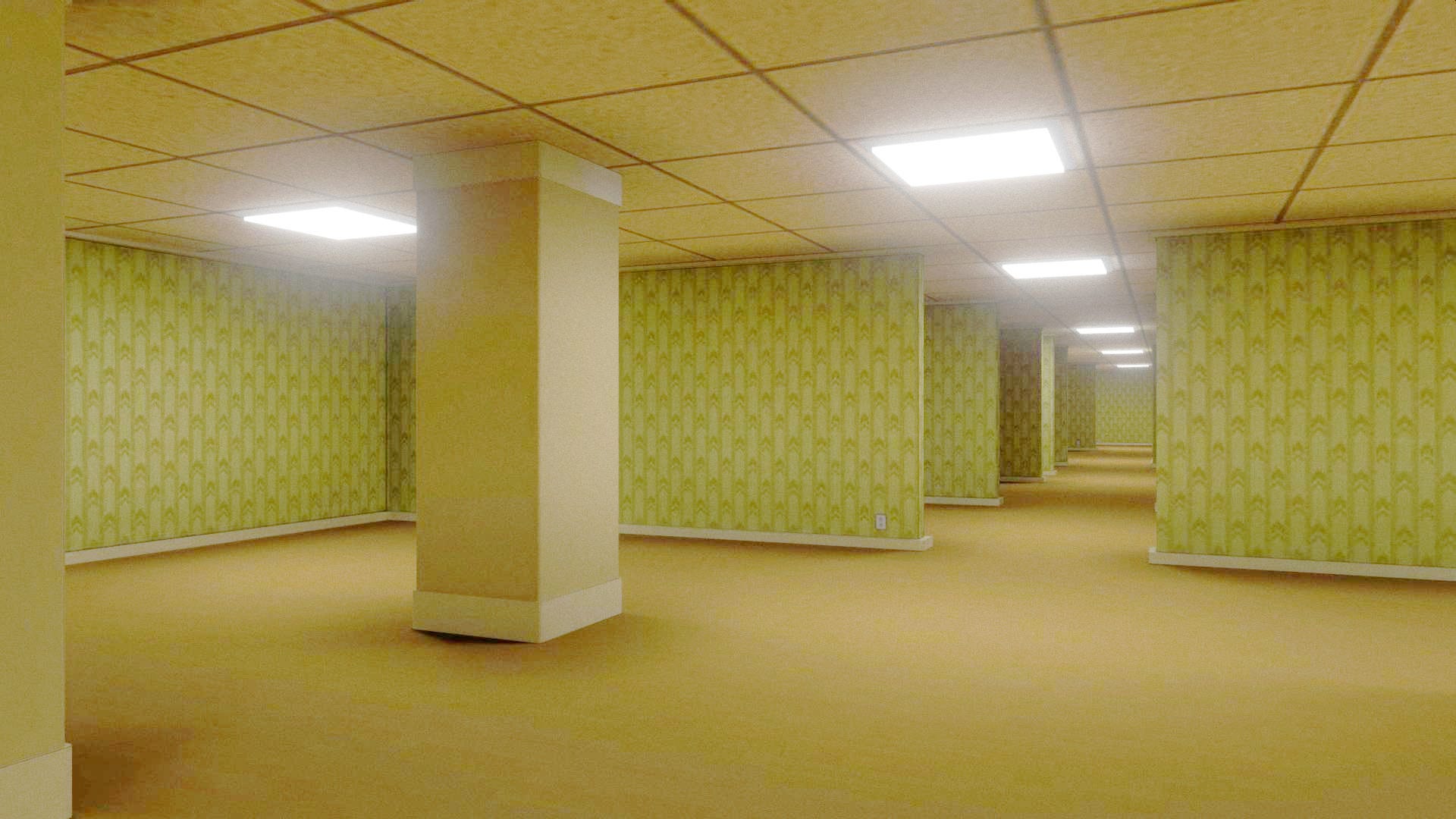
You may be confused how the new A24 movie Backrooms fits into these ideas. I think the film aims to comment on the dangers of derivative versions of reality. A central visual trait of the ‘entities’ in the backrooms is their distortion, resembling early AI image generation, with horrifyingly misshapen faces and extremities. Clark comments on the backrooms as containing “everything” that ever was, representations of the world outside, which are slightly off. The recurring analogy for what the backrooms are like is “describing a dog to a person who has never seen one before and asking them to draw it.” Similarly, artificial intelligence attempts to replicate humans and their creations without experiencing the realities of humanity. The added layer is that, as in the backrooms, AI slowly becomes derivative of its own products and hallucinations. It feeds upon itself. Today, there are pieces of pure AI text used to train AI.
I may have a naive hope that some form of AI, which is open-sourced, publicly-owned, and powered by renewable energy, may exist one day. I believe there is great potential in the internet if it were accessible to all and allowed people to tap into its wealth of information. There is potential for literacy to increase if we use the internet correctly; everyone in the world could have access to the largest library in human history. However, I fear that due to the monopolization of so many social platforms and their prioritization of rotting brains through quick dopamine hits to sustain mindless screen time, such a future is unlikely under our current economic structure.
In my view, the message of Backrooms is that a retreat from reality is dangerous. AI is a danger not because an LLM is inherently unethical, but because when it is utilized to replicate a world it has not experienced, it inevitably gets things wrong. AI cannot do human analysis, create meaningful art, or tell human stories. It can merely synthesize what humans have made before. Clark’s acceptance of irreality is an important element of the film. He finds comfort in the backrooms because the entities he surrounds himself with do not react to his narcissism or flaws. Still, his own derivative entity magnifies his worst traits. AI is bound to do the same; it is bound to emulate humanity, for better and worse, while still getting it slightly wrong. When you turn to a chatbot, it aims to please you; it aims to be a miracle worker that answers your every request. It is important that everybody realizes it has stark limitations
We must also recognize that part of the backrooms’ appeal is their sense of nostalgia. The feeling that we have experienced some space like it before in a past life. Nostalgia is a human feeling; it can be comforting, but it resembles AI in its distortion of reality. We, as humans, revise what happened in the past to make ourselves feel better. We glorify our childhood, we glorify the good old days, we retreat from reality into a lost time. The dangers of nostalgia, of AI, and of the backrooms are similar in their detachment from life. Screen addiction detaches us from nature, interacting with AI detaches us from human intelligence, and the backrooms literally detach their victims from the real world. And nostalgia, our own human-generated derivation of reality, removes us from the realities of history.
Nostalgia on the American right, which glorifies a traditional life with a wife, two kids, a picket fence, and a patriotic, homogeneous neighborhood, reflects a world that never existed based on prejudiced ideals. Nostalgia amongst American liberals, say for Obama 2008 or LBJ 1968, glorifies past ‘progressive’ victories while obscuring such politicians’ own complicity in American exceptionalism and imperialism.
Surely, I am a hypocrite for grandstanding on this topic as I am so online. I post on X, an app with an embedded AI algorithm owned by the richest man in the world, which supports plutocratic governance. But it is because I know so many of us online are experiencing a similar detachment from the real world that I feel compelled to write this. You should know that these ideas were not curated by a machine. I feel strongly that more people should turn to writing in rebellion against the internet’s infestation with automated slop. That means handwriting or typewriting that is drafted without the influence of Grammarly, ChatGPT, or any form of computer oversight. If you want to spell check it later and edit it for technicalities, fine, but the ideas and the feelings should be rawly human.
It is in this that I see writing as an art. It is a direct translation of organic human thought. It captures your feelings in the moment you are experiencing them. I’m writing this as I sit outside, the sun on my arms as I type, a Modelo by my side, and a bead of sweat on my forehead. AI cannot generate its work in this manner. Although I could write something that is nostalgic slop, rooted in irreality, or that spreads misinformation, even within those human flaws, a valuable analysis is to be had. Why do we retreat from our reality, and what kind of irreality do we retreat to? Clark retreats to a dinner table, surrounded by entities that neither talk nor feel. He wishes he could live amongst others without the burdens of human connection. Maybe this is why so many today have gotten “close” to AI chatbots: they have no feelings and regurgitate exactly what their users want to hear, thus they are the perfect partner.
One tension I find interesting in viewing Backrooms as an allegory for AI lies in the distinction between what is considered perfect and what is considered imperfect. Oftentimes, AI is technically perfect, particularly in writing, while in Backrooms, the distortions are plainly imperfect. The value of humanity, though, is its imperfection. Our ability to get things wrong, to have quirks, and to be unique in appearance and mind is what defines humanity. In other words, humans are perfectly imperfect, and computers are imperfectly perfect.
The solution now is not to define a particular ‘stance’ toward this technology, but to oppose its use in the arts and ownership under capitalism. I am a believer that it is often not technology itself that harms humanity, but human-made structures motivated by greed and power that cause the most suffering. Workers will be harmed by AI not merely by its existence, but by its use in cutting positions and inflating profits for the bourgeoisie. If productivity were increased and workers saw a subsequent gain from a reduced workweek and increased wages, maybe we would be having a different conversation. If data centers ran on closed-loop cooling systems powered by renewable energy and did not steal from public utilities, maybe we would have a different view of them. If those outside the imperial core weren’t surveilled and bombed through AI weapons systems, maybe opposition to AI’s exponential advancement and funding wouldn’t be so pertinent.
In this moment, there are many calls to action I could make, and I struggle to conclude this piece because it feels overwhelming. What I will urge is to connect to your own reality. Go and talk to people, to your neighbors, find out what people are thinking about right now, and maybe give them some friendly push back. I urge you to write, preferably by hand, and don’t show it to anyone. Don’t put it online for an AI to train on. I am fully aware that some machines will take what I’ve published online and use it to improve their skills, but it is just another thing we must consider. AI cannot invade our minds if we don’t let it. It cannot influence the way your hand moves across a journal page. It cannot alter the way we speak to other humans. We have mediums at our disposal that AI will never be able to replicate, no matter how hard it tries. Getting in touch with your own human expression and connections may be the most important task at hand. Artificial intelligence’s silver lining is that it has, more than anything else, defined what it means to be human. It has created a negation of human thought, a contrast which can be used to delineate the unique beauties of our brain’s output.
you know, as someone who's watched the backrooms recently and as an occasional writer, the allegory of the backrooms as generative ai is just hitting me on a deeper level. your work is brilliant.
saw ai actors in an ad today and just made me think abt how they expect people to be able to buy a product that they wouldn’t bother paying people to sell. haven’t seen the backrooms yet but this inspired me to watch !!