
Satanic Sense: Introduction
Thomas Paine's Demonic Caricature in Transatlantic Politics
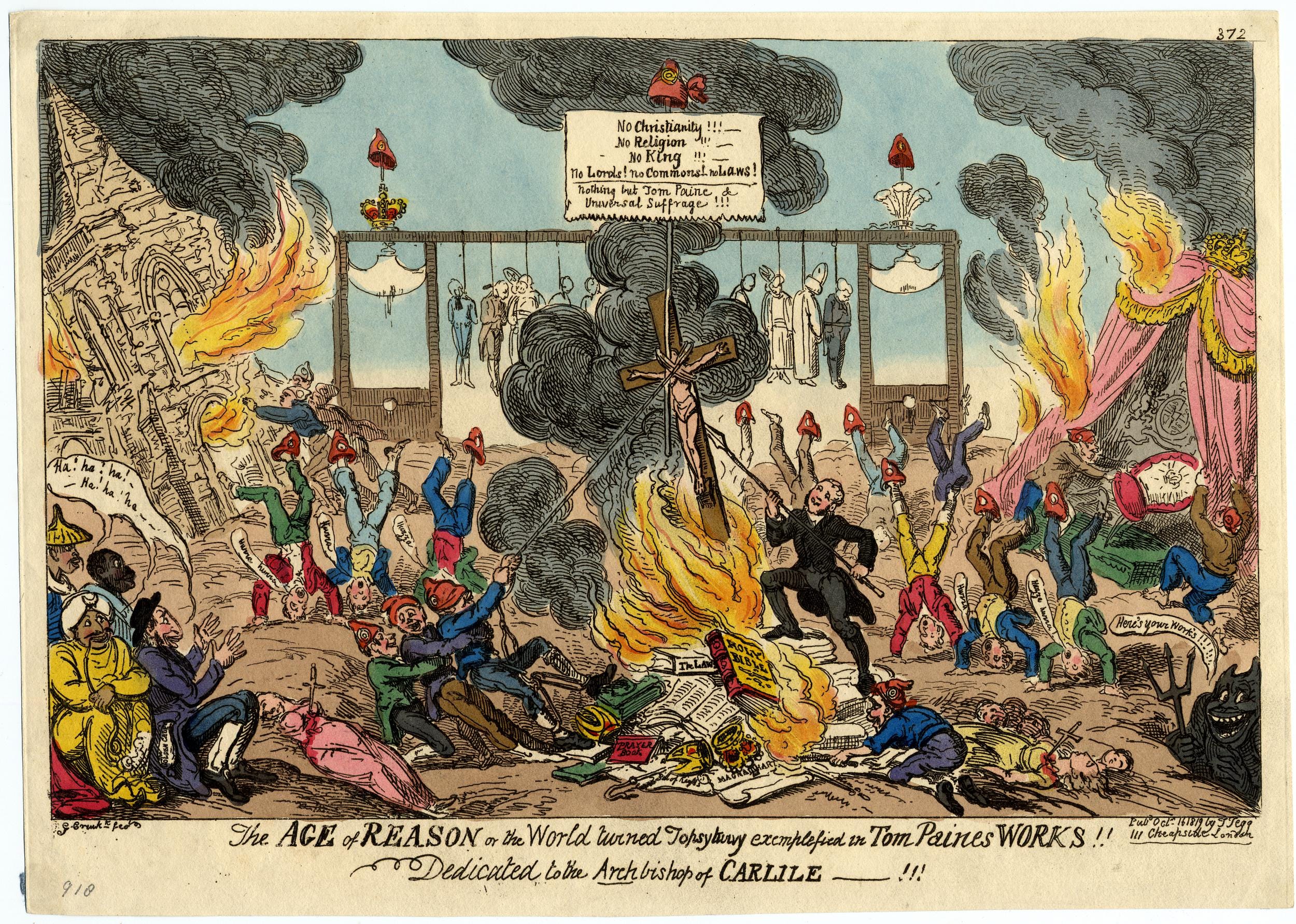
Figure 1: George Cruikshank, The Age of Reason or the World Turned Topsyturvy Exemplified in Tom Paines Works!!, October 16, 1819, British, hand-colored etching, published by Thomas Tegg, British Museum Satires, London. (Richard Carlile, a radical publisher in 19th-century Britain, is caricatured in the center with a content face as he places a Crucifix into flames).
Dear reader,
You must know that Tom Paine was a vile, low-class, radical whose wretched life was compelled by a desire to level our society and destroy all institutions. Just look at the image above; this is the world if Tom got his way. A world of treachery, misery, anarchy, and blasphemy. Look toward the lower-left corner, where the Jews, the Turks, the Africans, and the Asians delight at the sight of the destruction of Western civilization. Meanwhile, Satan rejoices in the lower-right corner at the abolition of morality. Without a monarch, without intellectual elites, without institutionalized religion, we would have to rely on ‘universal suffrage’, where all sorts of people can determine the proper way to govern.
We must reject the words of such wretched people; those of the lower classes, like Tom, have no time to study the science of politics. They do not know the word “balance” or “moderation”; they know nothing of “modesty” or “nobility.” The mixed governance of the aristocrats, the common people, and the divine King in the British Constitution is a perfect system, which equally considers the interests of different groups. It is only the craziest amongst the commons who possess the audacity of Tom to tell the refined gentlemen of our society what a constitution should look like. Paine’s popularity is frightening, and thus it is paramount that we do all in our power to counteract his demonic vision for a world of equality madness.
The preceding amalgamation of epithets toward Thomas Paine is not an authentic piece of writing from an opponent of his, nor is it my true opinion. Instead, it serves as an introduction to the ideological frame many of Paine’s foes possessed. The accompanying cartoon, titled The Age of Reason or the World Turned Topsyturvy exemplified in Tom Paine’s works!! (fig. 1), was published in 1819, ten years after Paine’s death. It serves a parallel purpose of synthesizing the political and religious critiques of Paine’s radically democratic ideology. Richard Carlile, the man at the center of the print, ran a publishing shop named ‘Temple of Reason,’ and was prosecuted for selling Paine’s works, such as Common Sense, Rights of Man, and The Age of Reason. In describing Carlile’s place in the image, scholar of the Romantic era Ian Haywood writes that he serves as “less a publisher than a necromancer . . . unleashing Paine’s Jacobin anarchy on the post-war world.” [1]
At the trial of Carlile for blasphemy and sedition, he used the publicity to read the entire text of the banned book, The Age of Reason, seizing the moment of attempted suppression to reach a wider audience. In this, Haywood argues, “demonization may actually have bolstered Paine’s reputation and ensured that he would continue to exert spectral power . . . energizing popular political culture with the ‘delicious poison’ of infidelism and republicanism.” [2] Time and again, across centuries, Paine’s character is almost never presented as a true representation of his thought; instead, he is either a saint or a monster in an imagined reality. Acknowledging Paine’s spectral nature in transatlantic politics during the ‘Age of Revolution’ allows this thesis to identify patterns and tropes in anti-Paine print culture in the late 18th and early 19th centuries.
Paine’s Pathologization
The facts of Paine’s life should not be in doubt. Most aspects are verifiable, and many of the disputes arise from onlookers’ ignorance. However, the story of Paine’s personal life has been shaped by many falsehoods. Throughout his public career and in the years that followed his death, some have projected their own wills and values onto the framing of his identity. While those who attempted to rehabilitate Paine’s image in the late 19th and early 20th centuries may have overcorrected by misattributing writings to him, the most enduring and damaging mistruths came from those who viewed Paine and his pen as a source of evil, infecting the world with democratic and deistic thought. It is from such pathologization of Paine that his character and worldview became associated with demonic wretchedness. By viewing Paine as a political football during the genesis of the United States, we gain insight into the transatlantic nature of early American political rhetoric and the prevalence of elite power in both England and America.
In this thesis, I argue that the American ruling class repurposed popular British print culture tropes in the construction of an image of Paine as an ‘immoral, mad, drunk infidel’ to pathologize radical democratic thought in the United States. However, this relentless campaign of character assassination possessed a paradoxical role, as the attempts to exorcise Paine’s legitimacy only guaranteed the specter of his ideals to persist beyond his death.
Historiography
Most historians agree that Paine’s Common Sense was pivotal in framing the ‘patriot’ argument for independence around the recognition of universal rights, the rejection of hereditary monarchy, and the legitimacy of revolution against an oppressive state. Prominent early American historian Gordon S. Wood describes Common Sense as the “most important pamphlet written in the American Revolution,” and while it “did not cause Americans to think of declaring independence, it did express more boldly and eloquently than any other writing what many already believed.” [3]
The question of how to situate Paine within the broader ideological currents of the Revolution has generated debate amongst scholars. Bernard Bailyn’s foundational work, The Ideological Origins of the American Revolution, emphasizes the role of English Whig constitutional thought and classical republicanism in shaping the political imagination of the founding generation, including Paine as one voice among many in an essentially transatlantic conversation about liberty and legitimate government. Still, Bailyn has eloquent descriptions of Paine’s essential philosophy of government in Common Sense as the promotion of institutions devised to conform “not to inherited prejudices and the accidents of history, but to true principles of human liberty,” urging Americans to “cast off the chains that tie them to England and its corrupt monarchy, and as independent states create unicameral assemblies chosen annually by a ‘more equal’ system of representation.” [4] Bailyn’s interpretation of the American Revolution as a largely intellectual struggle dominates much of the teaching of early American history, although it is challenged by scholars who foreground the social and economic dimensions of revolutionary politics. Howard Zinn’s A People’s History of the United States offers a reading of Paine as a champion of the laboring classes and situates his writings within a tradition of popular resistance to elite power. [5] Eric Foner’s Tom Paine and Revolutionary America productively navigates Paine’s place between such framings, integrating the political, intellectual, and social history of the American colonies to situate Paine’s ideas within the working-class culture of Philadelphia, where he first wrote and found his audience. [6]
Biographies have done much to shape the popular image of Paine (even while he was alive), often with consequences for subsequent scholarship. John Keane’s Tom Paine: A Political Life is, in my opinion, the most comprehensive biography to date, tracing Paine’s early life, transatlantic career, and retelling the complexity of his political thought with a fresh eye and engaging analysis. [7] Harvey J. Kaye’s Thomas Paine and the Promise of America offers a more explicitly celebratory account, arguing for Paine’s relevance as a democratic radical and placing him at the center of the perceived American tradition for egalitarian politics. [8] Both works are essential reads for potential Paine scholars.
Recent considerations of Paine’s writings have examined his public silence on slavery and non-European revolutions, raising questions about the universal intent of his egalitarian ideals. Modern textual analysis conducted by the Thomas Paine Historical Association has demonstrated that some antislavery essays were misattributed to Paine by editors in the nineteenth and twentieth centuries, including the 1775 “African Slavery in America.” This finding has upended decades of scholarship portraying Paine as a vocal abolitionist. [9]
Some private correspondence shows Paine wrote in support of ending the slave trade. In 1790, while Paine was residing in France, he wrote to Benjamin Rush, “I despair of seeing an abolition of the infernal traffic in Negroes. We must push that matter further on your side of the water.” In 1805, on the topic of Liverpool, a city whose “ships delivered an estimated 1,171,171 slaves to the New World, making it the most important port of departure for transatlantic slaving voyages before the nineteenth century,” Paine wrote to Thomas Jefferson:
It is chiefly the people of Liverpool that employ themselves in the slave trade and they bring cargoes of those unfortunate Negroes to take back in return the hard money and the produce of the country. Had I the command of the elements, I would blast Liverpool with fire and brimstone. It is the Sodom and Gomorrah of brutality. [10]
Anthony Dean Rizzuto’s article “Paine and Race,” published in Early American Studies in 2025, offers a sustained critical examination of Paine’s relation to race, pointing out that Paine’s known writings demonstrate a deafening silence on slavery and an active participation in the construction of a white American identity that defined “Americans” against Black and Indigenous peoples. [11] This is evidenced by a line in Common Sense, which claims the British “hath stirred up the Indians and the Negroes to destroy us,” defining ‘us’ as white settlers. [12] Rizzuto views Paine as essential to the settler colonial strategy of the era and contends that his rhetoric of universal freedom operated through the lens of “racial liberalism.” Such a framework designated freedom and the United States as reserved for white people, implying that it was the rights of white men that were paramount. [13]
Even in the few sentences Paine writes on slavery, his arguments are sometimes centered around the security of white people. In an 1804 letter, Paine writes that the injustice of slavery should end because it would inevitably cause revolt by enslaved people, asking, “Do you want to renew in Louisiana the horrors of Domingo?” [14] In such a statement, Paine reflects a white fear of Black-led revolution, prioritizing the avoidance of further revolutionary violence over the extension of proclaimed universal rights to non-white people. Rather than emphasizing the horrors of slavery, its effects on the people bound by physical chains, or the rights that all enslaved people inherently possess, Paine wrote his political rhetoric for an evidently white audience. It is from this evaluation that we should limit the praise of Paine’s political works as universally egalitarian, as he was complicit in the exclusion of non-whites in the ‘nation’ of America.
The limits of Paine’s worldview necessitate a comparative attention to other radical writers of the era. For example, the Anglo-Irish writer Edmund Burke’s relationship with Paine is read by scholars as a contest between two fundamental theories of government, Burke valuing the conservative inheritance of tradition and Paine deferring to the present will of society. [15] Compared to Burke, Paine was a novel “left-wing” public intellectual committed to the ‘progression’ of humanity over time. Meanwhile, a comparison with Thomas Jefferson underscores the importance of political authors’ personal backgrounds. Although Paine shared many of the same Enlightenment premises as Jefferson, Paine pushed them to more radical conclusions than Jefferson. Unsurprisingly, an elite agrarian slave-owning republican from Virginia came to a starkly different conclusion than Thomas Paine, an artisan urban rentier republican in Philadelphia. [16] Such material differences have drastic implications for the ideology they propelled, as political beliefs are so often derived from personal circumstances.
Scholarship on the “Revolution Controversy”, which stemmed from the publication of Reflections on the Revolution in France by Edmund Burke and Paine’s response in Rights of Man, has illuminated Paine’s position on gender equality. Eileen Hunt Botting, in an article comparing Mary Wollstonecraft’s and Paine’s writings, notes how although Paine’s early works included “latent or overt misogyny”, over the course of his career, particularly with the publication of Agrarian Justice in 1797, his writing “either explicitly or implicitly endorses women’s equal rights with men, especially welfare rights but also political rights such as suffrage.” [17] Paine, throughout his career, “socialized with some of the leading women’s rights advocates of the era, including Benjamin Rush in Philadelphia, Condorcet and Théroigne de Méricourt in Paris, and Mary Wollstonecraft in London and Paris”, a circle which we can reasonably infer pushed his thoughts beyond previous limitations. [18]
A new collection of Thomas Paine’s works assembled by the Thomas Paine Historical Association includes a greatly expanded corpus of attributions, among them several works published under pseudonyms after Paine returned to England in 1787, some of which reveal engagement with abolitionist debates. The anonymized nature of many publications in the late 18th and early 19th centuries makes attribution difficult for scholars, with Gary Berton, president of TPHA and editor of the new collection, noting that it is likely “Paine led a group of writers in a collaborative manner to avoid discovery.” [19] Nevertheless, the image of Paine as an explicitly abolitionist writer remains difficult to sustain on the basis of his verified published writings.
While scholars have long identified the character attacks Paine endured in his own lifetime and beyond, placing such attacks within a transatlantic political history context allows the deliberate propagandization of his image to be examined more thoroughly. Due to the uncertainty of the future of Paine’s attributed works, this current research does not seek to adjudicate the nature of Paine’s rhetoric or the ultimate coherence of his political ideas. Rather, it is concerned with the gap between Paine’s personal reality and the propagandized image constructed around him. By moving beyond ideological analysis, this thesis will provide a narrative on why Thomas Paine’s influence was diminished in the United States' origin story.
[1] Ian Haywood, Romanticism and Caricature (Cambridge: Cambridge University Press, 2013), 103.
[2] Haywood, Romanticism and Caricature, 107.
[3] Gordon S. Wood, Revolutionary Characters: What Made the Founders Different (New York: Penguin, 2006), 209.
[4] Bernard Bailyn, The Ideological Origins of the American Revolution, 50th anniversary ed. (Cambridge, MA: Harvard University Press, 2017), 286.
[5] Howard Zinn, “Tyranny is Tyranny” in A People’s History of the United States (New York: Harper Perennial Modern Classics, 2015), 59–75.
[6] Eric Foner, “Paine’s Philadelphia,” Tom Paine and Revolutionary America (New York: Oxford University Press, 1976), 19-71.
[7] John Keane, Tom Paine: A Political Life (Boston: Little, Brown, 1995).
[8] Harvey J. Kaye, Thomas Paine and the Promise of America (New York: Hill and Wang, 2005).
[9] Gary Berton et al., “Examining the Thomas Paine Corpus: Automated Computer Authorship Attribution Methodology Applied to Thomas Paine’s Writings,” in Scott Cleary and Ivy Linton Stabell, eds., New Directions in Thomas Paine Studies (New York: Palgrave Macmillan, 2016), 31–47.
[10] Thomas Paine, “To Thomas Jefferson,” January 25, 1805, in The Complete Writings of Thomas Paine, ed. Philip S. Foner, vol. 2 (New York: The Citadel Press, 1969), 1462. On the number of enslaved people transported by Liverpool ships see: Kenneth Morgan, “Liverpool’s Dominance in the British Slave Trade, 1740–1807,” in Liverpool and Transatlantic Slavery, ed. David Richardson, Suzanne Schwarz, and Anthony Tibbles (Liverpool: Liverpool University Press, 2007).
[11] Anthony Dean Rizzuto, “Paine and Race: Ideologies of Racial Liberalism and Settler Colonialism in the Founding of the United States,” Early American Studies 23, no. 2 (Spring 2025): 177–214.
[12] Paine, Common Sense in Complete Writings, vol. 1, 39.
[13] Rizzuto, “Paine and Race”, 207.
[14] Paine, “To the French Inhabitants of Louisiana” in Complete Writings, vol. 2, 968.
[15] R. R. Fennessy, Burke, Paine, and the “Rights of Man” (The Hague: Catholic University of Louvain, 1963), 147-148.
[16] Wood, “The Trials and Tribulations of Thomas Jefferson”, in Revolutionary Characters, 93-117.
[17] Eileen Hunt Botting, “Thomas Paine Amidst the Early Feminists,” in Selected Writings of Thomas Paine, (New Haven: Yale University Press, 2014), 630.
[18] Botting, “Thomas Paine Amidst the Early Feminists,” 632.
[19] Gary Berton, “Who Wrote ‘African Slavery in America’?” Studies in Thomas Paine (Thomas Paine Historical Association, February 2025).